The number nobody on TikTok wants to tell you is that there isn't a credible one. Every wedding site quotes an average US stationery spend, and those figures trace back to studies we cannot open and verify at the source — so we won't print one here under someone else's brand. What we can do instead is price the thing from the bottom up.
A printed suite is built from per-piece card stock, the printing method, envelopes, outbound postage, reply-envelope postage, and one more charge for every insert. Add those lines up and a mainstream printer lands in the hundreds for 100 guests; letterpress on cotton paper runs past a thousand. Lengthen the guest list and every one of those lines grows with it — along with the calligrapher, the wax seals, and the postage upgrade because your envelope is too thick for a standard stamp.
This is the honest cost breakdown for wedding invitations in 2026 — five real paths, hidden costs revealed, and one big question to ask before you commit to any of them.
The hidden costs nobody warns you about
When wedding planners quote you a stationery budget, here's what they're including (and what often gets missed):
Visible costs:
- Invitation card itself
- Envelope
- Printing
Hidden costs that add up fast:
- Save-the-date ($90-200 for 100 — yes, separately)
- RSVP card + RSVP envelope ($80-150)
- Inner envelope + tissue paper (if formal — $30-60)
- Postage outbound ($65-120 — heavier cards cost extra)
- Postage RSVP return ($65-120 — you pay for guests' replies)
- Calligrapher ($3-6 per envelope addressed — $300-600 for 100)
- Wax seals + wax ($60-120)
- Belly band / ribbon ($40-90)
- Map insert / details card ($80-150)
- Proof revisions ($25-75 per round, after the first)
A simple "$300 invitations" quote becomes $750-1,400 by the time everything ships. This is normal. This is also why the digital path is reshaping the category.
The 5 real paths in 2026
Path 1: Bespoke designer + letterpress + calligraphy
Cost (100 guests): $1,200 - $2,400 Time: 8-12 weeks
This is the path your wedding-planner Instagram saves are showing you. A real designer, real letterpress production (often in a Brooklyn or Portland studio), a real calligrapher addressing each envelope by hand. Cotton paper from Crane or Bella Figura. Hand-applied wax seals.
What's included: Custom design from scratch, 2-3 rounds of proofs, letterpress production on cotton paper, RSVP cards + envelopes, hand-calligraphed addresses, inner envelopes, wax seals.
Who it's for: Highly formal weddings ($100K+ total budget), weddings featured in Brides magazine, couples whose wedding-budget allocation puts stationery in the top 5 line items.
Honest truth: The product is genuinely beautiful and your guests will save it forever. It's also more than most people spend on their entire wedding flowers.
Path 2: Custom (Minted, Zola, Paper Source)
Cost (100 guests): $400 - $700 Time: 4-6 weeks
Online platforms that offer designer-led templates you customize through their web tool. Real printed cards, but you pick from existing designs rather than commissioning bespoke. Quality of paper varies — Minted's premium options are excellent; their basic line is closer to thick cardstock.
What's included: Customized design from template library, printed cards + envelopes, RSVP cards, basic recipient address printing (no hand calligraphy).
Hidden costs: Postage ($120-180 round-trip for 100 guests), envelope upgrades, expedited shipping if you're behind schedule.
Who it's for: Couples who want the look of designer paper without the bespoke price tag. The most-traveled path among couples 28-35 with budgets between $30K-60K total.
Path 3: Print-at-home + DIY assembly
Cost (100 guests): $80 - $200 + your time Time: 2-3 weekends
Buy a digital design from Etsy ($15-40), download it, take it to FedEx/Office Depot/Vistaprint or print at home. Buy envelopes from Paper Source ($30-60). Address each one yourself in your handwriting (or fake calligraphy by tracing). Apply postage.
What's included: Whatever you put in. Most DIY couples skip the RSVP card and ask guests to RSVP via website.
Hidden costs: Toner cartridges if printing at home ($40-80), wasted prints from misaligned cards, the value of your three weekends.
Who it's for: Couples with design skills, couples on tight budgets, anyone who legitimately enjoys craft projects. Not for anyone who underestimates how long addressing 100 envelopes takes (~3-5 hours).
Path 4: Animated digital invitation (Digittify, similar studios)
Cost (100 guests): $19.99 Time: 5 minutes after picking template
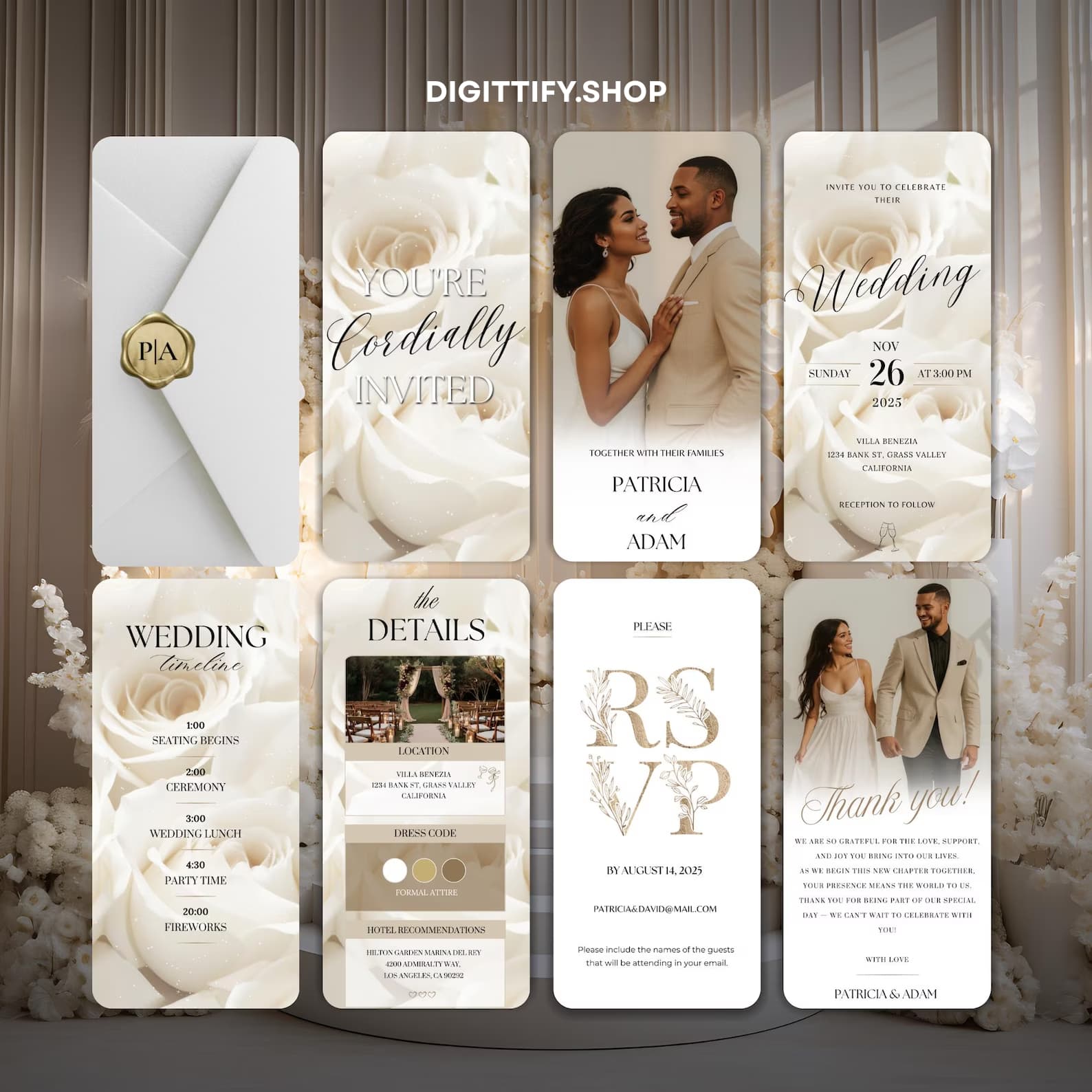
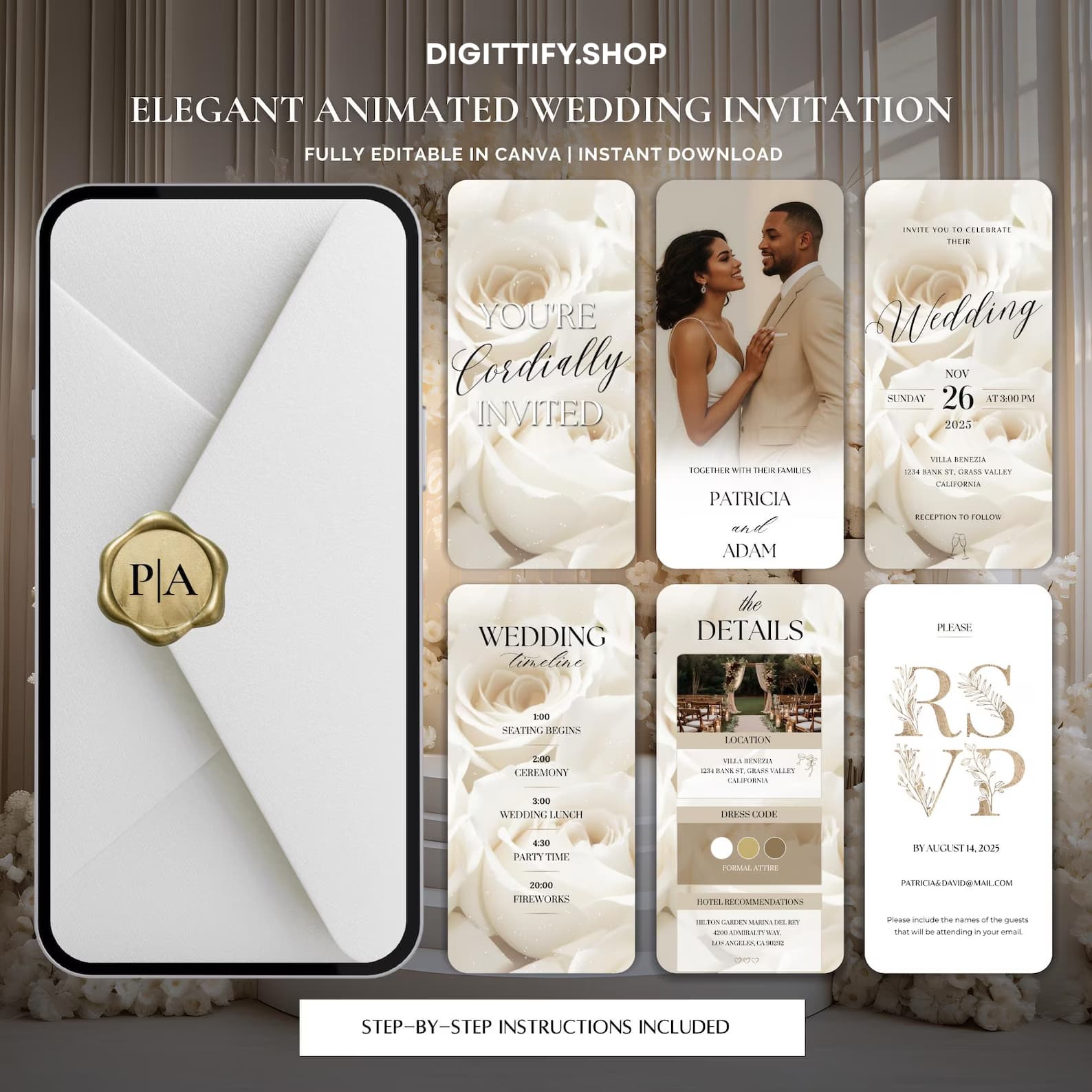
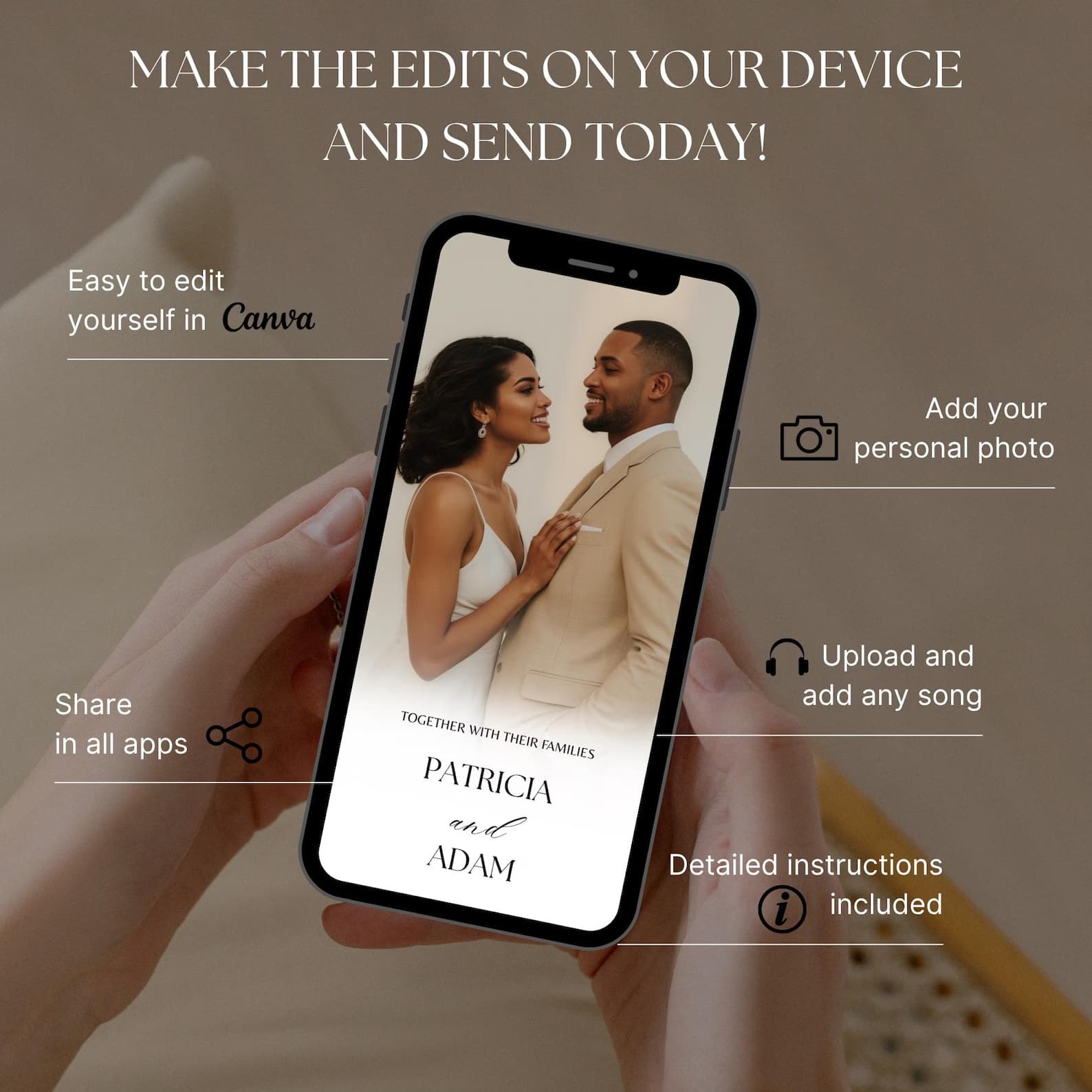
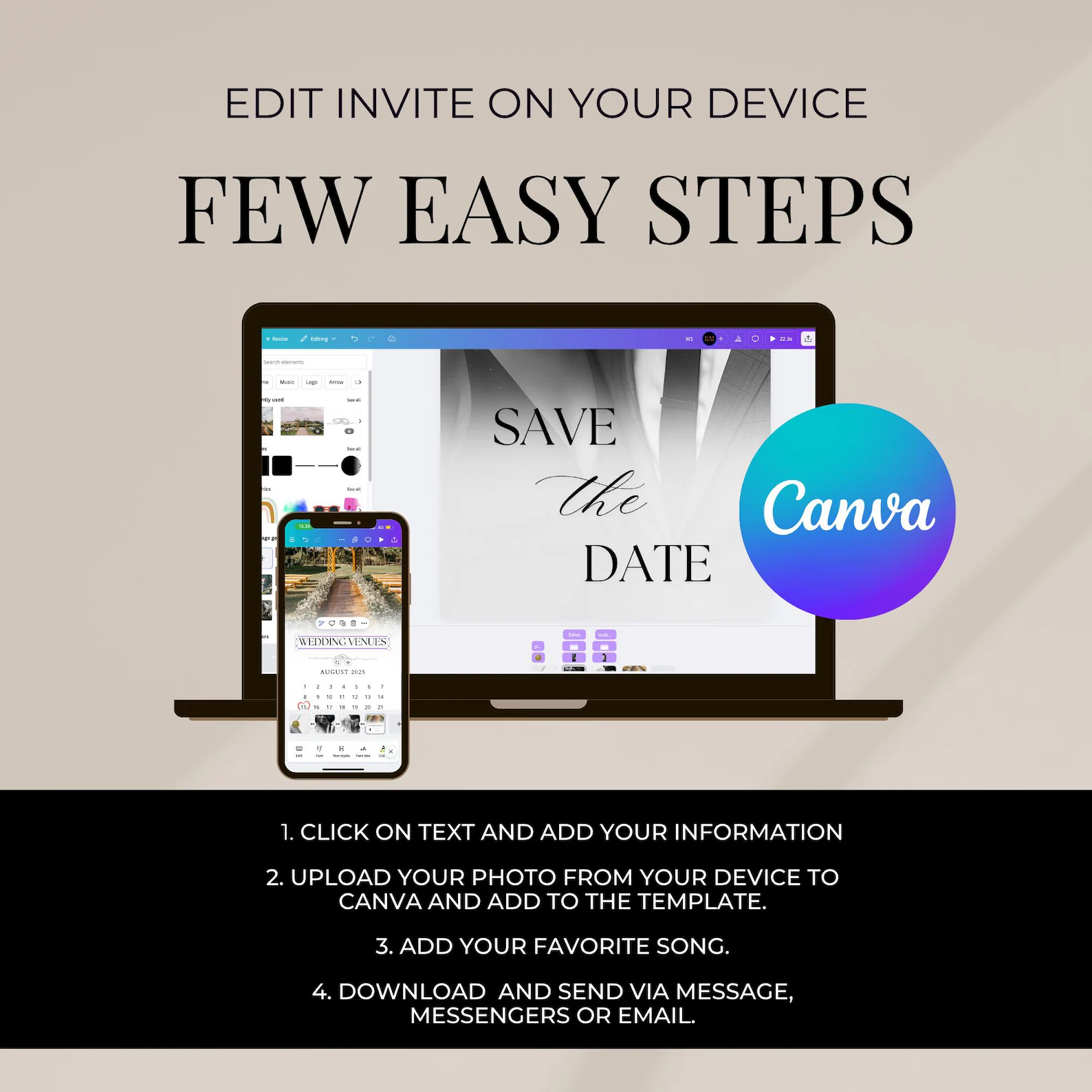
A 15-30 second video file you customize in your free Canva account and send by WhatsApp, iMessage, email, or QR code. Same designer-quality aesthetic as Path 2 — but in motion, with music, your photos, and zero printing.
What's included: Full template (Save the Date + Invitation + RSVP card + details card + thank-you card in bundles), 5+ color palettes, photo placeholder, music upload support, step-by-step PDF guide, lifetime re-edits.
Hidden costs: None. The all-in price is the all-in price.
Who it's for: Most couples in 2026, especially those with international guest lists, time-compressed timelines (under 6 months), or budget priorities elsewhere (venue, photographer, open bar).
Path 5: Hybrid (digital + 5-10 printed for grandparents)
Cost (100 guests): $35 - $80 Time: 5 minutes + one trip to a print shop
Buy an animated digital template ($19.99). Send digital to your 90+ connected guests. Print 5-10 traditional flat cards (from the same template's static export) for grandparents and the relatives who'd be most upset by digital.
Print cost: $15-30 for 5-10 cards at FedEx Office or a local print shop.
Who it's for: Couples who want the cost savings of digital without alienating elderly relatives. This is the fastest-growing path in 2026 — it accommodates everyone.
The $19.99 path, with the same aesthetic as the $700 path.
Digittify templates were designed by stationery designers who left bespoke studios to make this accessible. The aesthetic standards are the same — the price is 95% less.
Why are paper wedding invitations so expensive?
Three real reasons (not the conspiracy theory that the wedding industry is rigged):
1. Letterpress is genuinely artisan work. Real letterpress production involves polymer plates pressed individually into cotton paper. Each card takes 30-60 seconds of skilled labor. Multiply by 100 invites + 100 RSVPs = 200+ presses. Labor at $40-80/hour adds up.
2. Paper costs are real. Crane cotton paper costs $1.50-2.50 per sheet. Even before printing, your 100-invitation envelope is using $200-300 of raw paper materials.
3. Calligraphy is hours of skilled labor. A calligrapher addresses 15-25 envelopes per hour. For 100 envelopes at $50/hour, that's $200-330 just for the addresses.
The pricing reflects real input costs. The question is whether those inputs are creating value for your wedding, or just inheriting a tradition from before phones existed.
“The couples I work with in 2026 split roughly 50/50 between paper and digital. The decision usually comes down to whether the invitation is part of the wedding's aesthetic statement (paper, expensive) or just the logistics of getting guests to the venue (digital, cheap).
”
When paper is genuinely worth the price
Three scenarios where the math actually works:
-
The invitation IS part of your wedding's visual identity. Highly aesthetic weddings (featured in editorial magazines, professional wedding portfolios) often use the invitation suite as a design statement that gets photographed, shared on Instagram, and remembered. Here, the $1,000 spend produces $5,000 of aesthetic value via every channel that re-shares it.
-
You're cementing an heirloom moment. Some couples want their 2055-aged children to find their wedding invitation in a drawer. A video file in iCloud doesn't deliver that. A letterpress card does.
-
Your wedding is in 2027 or later AND your aesthetic is deeply traditional. Truly formal weddings (white-tie, royal-style, Episcopal/Greek Orthodox with engraved everything) maintain a paper-only norm that hasn't moved.
For everyone else: the value math has tilted decisively digital since 2024.
Cost-per-guest, the more useful metric
Wedding stationery is usually quoted in "for 100 guests" — but the real budget question is the per-guest cost, especially when comparing paths:
| Path | Cost per guest (100) | Cost per guest (200) |
|---|---|---|
| Bespoke designer | $12-24 | $9-18 |
| Custom (Minted/Zola) | $4-7 | $3-5 |
| Print-at-home DIY | $0.80-2.00 | $0.40-1.00 |
| Animated digital | $0.20-0.50 | $0.10-0.25 |
| Hybrid (mostly digital) | $0.35-0.80 | $0.20-0.40 |
Notice the scaling: paper paths get only marginally cheaper per guest at higher counts (you save on design but envelopes and postage are linear). Digital paths get drastically cheaper as guest count grows — sending to 200 guests costs the same as sending to 100.
The decision framework (4 questions)
Ask yourself, in order:
-
Is your wedding less than 6 months away? → Bespoke is logistically impossible. Choose digital, hybrid, or Minted/Zola express.
-
Is your wedding stationery budget over $1,000? → If yes, you can afford any path. Decide based on what your wedding's aesthetic identity actually requires.
-
Is your guest list >50% international or >75% under 50? → Digital wins on logistics + lands better with your audience.
-
Do you want a physical keepsake for yourself? → If yes, print ONE copy of whatever you choose. You don't need 100.
Frequently asked
- What is the average cost of wedding invitations in 2026?
We don't publish an average, because the stationery averages in circulation cannot be verified at their source and a figure we cannot check isn't worth printing. Price it from the bottom up instead: for 100 guests a printed suite runs from roughly $120 at a budget printer to $1,400 and beyond for letterpress, before outbound postage, reply-envelope postage and inserts. An animated digital suite removes the per-guest cost entirely — ours is $19.99 once, for any guest count.
- Are digital wedding invitations cheaper than paper?
Yes, by a wide margin. A premium animated digital invitation runs $19.99 for unlimited guests, compared to $400-$700 for custom-printed sets (Minted/Zola) and $1,200+ for bespoke designer paper. The savings come from zero printing, zero envelopes, zero postage.
- Why are wedding invitations so expensive?
The cost reflects real artisan labor (letterpress production at 30-60 seconds per card), premium paper materials ($1.50-2.50 per sheet of cotton paper), and calligraphy hours ($50/hour, 15-25 envelopes addressed per hour). Hidden costs like postage, RSVP-return postage, and proof revisions add 40-80% on top of the visible quote.
- Can I get good wedding invitations under $100?
Yes, via digital. A premium animated digital invitation suite from a designer studio costs $19.99 for unlimited guests. The aesthetic quality matches $400-$700 printed alternatives. The DIY print-at-home path can also land under $100 for materials, but adds 2-3 weekends of your time.
- Do I need to send physical invitations or are digital ones acceptable?
In 2026, digital invitations are socially accepted for the majority of weddings. The exceptions are highly formal ceremonies (white-tie, certain religious traditions), weddings where the invitation is part of the aesthetic statement, and guest lists with significant elderly demographics. For these cases, the hybrid path (90+ digital, 5-10 printed) is the common solution.
What we'd recommend
If your wedding is in 2026 with a guest list of 60-200 mostly-smartphone-using guests and a budget you'd rather spend on the venue, photography, or food:
Choose digital ($19.99). Print 5-10 physical cards for grandparents and the relatives who'd be most disappointed. Total spend: $35-80. Time spent: 5 minutes + one trip to FedEx.
If your wedding is formal, traditional, or styled as an editorial aesthetic statement:
Choose Minted/Zola custom ($400-700) or bespoke designer ($1,200+). The paper genuinely matters here. Don't fight it.
Most readers of this article fall in the first category. That's why we're writing this and why Digittify exists. But the second category is real and we're not pretending it isn't.
Find out your real cost in 30 seconds.
Pick a tier (Essential / Couple Bundle / Suite), see the exact price including any active discount. No hidden fees, no postage surprises, no envelope-thickness upgrades.